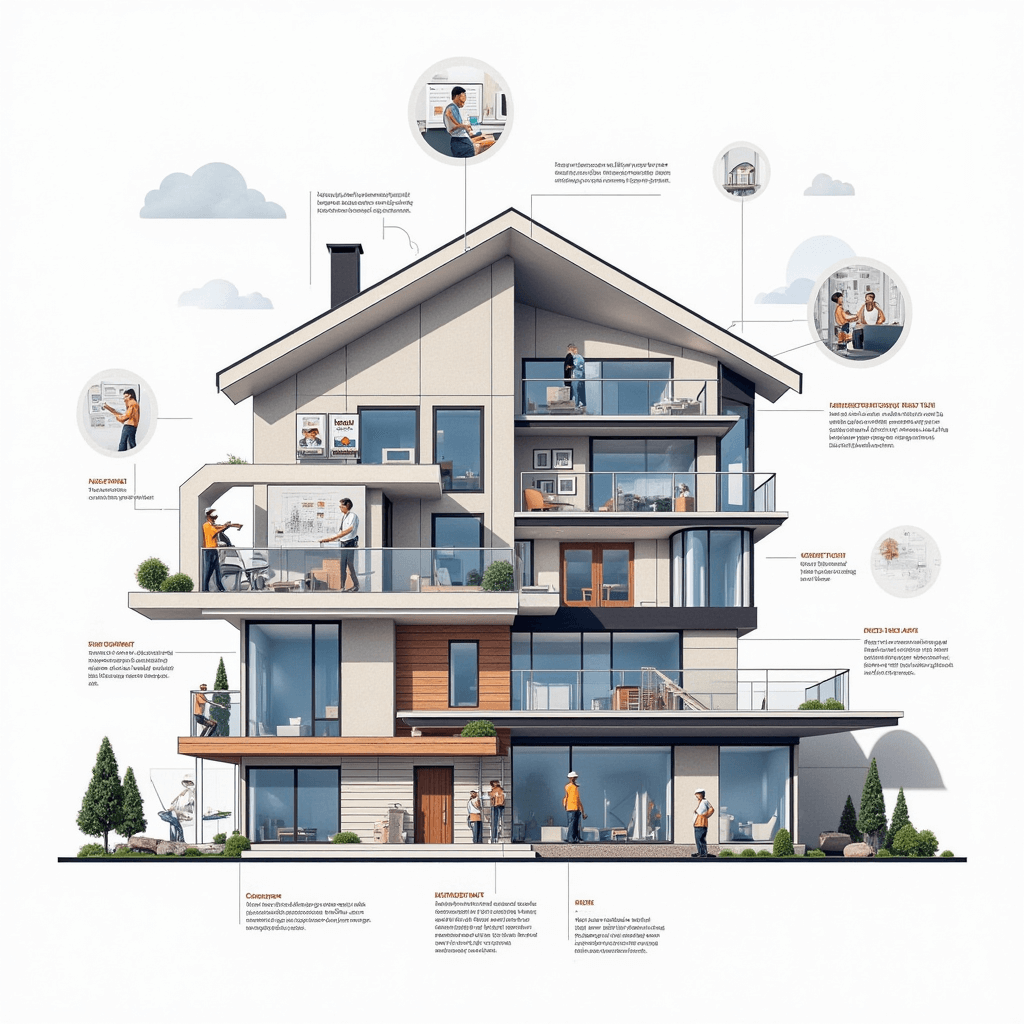
One of the biggest challenges in custom home building is understanding what your home will actually cost—and why. This cost guide breaks down pricing structures, budget considerations, and the real factors that influence custom home costs in the DMV, from site conditions and design complexity to material choices and permitting. Rather than relying on misleading price-per-square-foot estimates, homeowners will gain a realistic framework for budgeting, planning, and aligning expectations before committing to a custom build.
Building a custom home is one of the most ambitious projects a homeowner can undertake — not simply because of the financial investment, but because of the sheer number of decisions, approvals, trade partners, and variables that shape the journey from concept to keys. And nowhere is this process more intricate, more regulated, or more dependent on careful planning than in the DMV, particularly Northern Virginia.
The Washington metropolitan region is a study in contrasts: dense urban lots in Arlington with strict zoning overlays, wooded acreage parcels in Great Falls requiring environmental sensitivity, established neighborhoods in McLean where architectural consistency matters, and historic pockets in Alexandria where every modification passes through layers of review. To build a custom home here is to navigate some of the most complex residential development conditions in the country — and to do it well requires clarity, foresight, and an understanding of how the region actually works.
This guide was created for homeowners who want to build a custom home in Northern Virginia but don’t want to rely on fragmented information, general national advice, or surface-level blog posts. What you’ll find here is not the typical “step-by-step home building list” you’ve seen repeated online. This is a ground-up, fully integrated, region-specific guide rooted in the realities of building in Fairfax County, Arlington County, Loudoun County, and the surrounding cities where demand for high-quality custom homes is consistently strong.
Most homeowners begin this journey the same way: with inspiration. A certain architectural style catches their eye. A kitchen layout that finally solves the pain points they’ve lived with for years. A neighborhood they’ve always admired — McLean, Great Falls, Langley, or Vienna — suddenly feels within reach. But between inspiration and reality lies the part no one sees in glossy magazines or online design galleries: the machinery of custom home building.
That machinery includes some of the most important decisions of the entire project — decisions that define cost, timeline, quality, and long-term livability long before a single wall goes up.
What soil conditions exist on your lot?
Which zoning district are you in — and how does it affect height, FAR, setbacks, lot coverage, and footprint?
Does the site require land disturbance permits, stormwater management plans, or tree preservation reviews?
Is the architectural style you love compatible with the regulations of your neighborhood?
Which structural systems make sense for the long-term durability goals of your home?
How do you protect the budget early, when changes are least expensive and impact is greatest?
These are the questions that determine whether a project flows smoothly or becomes a case study in avoidable delays, cost overruns, and homeowner frustration.
The truth is that most content on the internet oversimplifies custom home building. It treats the process as linear, predictable, and uniform — as if building a custom home in South Carolina, Texas, Utah, Nevada, or Florida is identical to building one in Arlington or McLean. But Northern Virginia isn’t just “another market.” It has:
Building here is both an opportunity and a challenge. Done well, the end result is a home that fits you perfectly, honors the character of its surroundings, and stands as a long-term investment in one of the strongest real-estate markets in the country.
But done without the right guidance, it can become overwhelming — not because you made the wrong choices, but because you made them without all the information.
That is the purpose of this guide.
This is the definitive, start-to-finish roadmap for building a custom home in Northern Virginia — from evaluating a lot to developing a design, understanding timelines, selecting the right builder, preparing for construction, avoiding common pitfalls, and knowing what actually happens behind the scenes throughout the process.
You will learn:
The aim of this guide isn’t to sell you anything. It’s to give you the knowledge, clarity, and confidence to approach a custom home project with both excitement and control.
Another reason this guide exists is because, for all the resources available online, truly comprehensive information about building a custom home specifically in Northern Virginia is surprisingly rare. You can easily find national checklists or generalized blog posts, but very few sources break down the DMV context with enough depth to prepare homeowners for what actually happens.
This region is unique.
The guidance must be unique.
And this guide is built to reflect that.
Whether your goal is to build a modern home in McLean, a transitional home in Vienna, a contemporary infill in Arlington, or an estate-style home on acreage in Great Falls or Fairfax Station, the principles you’ll find here will help you understand what’s ahead — and how to navigate every phase with intention.
And finally, a word about builders.
Choosing a builder is not the first step — yet it is the step that most heavily influences every stage that follows. The right builder shapes your budget realistically, protects your schedule, helps narrow your design preferences, guides you through feasibility, handles permitting complexity, and assembles the team of professionals who will bring your vision to life. This guide will help you understand how to evaluate them, what to look for, and how to cut through the noise of marketing to identify true expertise.
Over the next sections, we will go deep: deeper than most resources go, deeper than a typical homeowner expects, and deep enough to ensure that the decisions you make — from structural systems to permitting strategies to design priorities — are informed, intentional, and aligned with how the DMV market truly works.
Your custom home begins long before construction.
It begins with clarity.
And clarity begins here.
“Custom home building” is one of the most commonly used terms in residential construction — and also one of the most misunderstood. Homeowners often hear the word custom and assume it means total freedom, unlimited possibilities, and an entirely blank slate. Builders sometimes use the term loosely, applying it to everything from slightly modified production models to semi-custom plans that allow buyers to choose finishes but not layouts.
But in Northern Virginia — where zoning regulations, lot constraints, architectural review boards, soil conditions, and neighborhood context shape almost every decision — the true meaning of “custom home building” becomes both more specific and more consequential. To build a genuine custom home here is to embark on a process that is as much strategic as it is creative.
The simplest definition is this:
A custom home is one designed and built uniquely for you, on your lot, with no pre-existing floor plan dictating its form.
But that definition doesn’t capture the full reality.
To understand what you’re actually signing up for, you need to understand what makes a home custom, what separates it from semi-custom or spec-built homes, and why the distinction matters so much in the DMV.
A spec home is designed, financed, and built entirely by a builder without a specific buyer in mind. The builder chooses the layout, the finishes, the systems, and the design long before the home is marketed. These homes appeal to buyers who want something new but don’t want to deal with construction.
Pros: Faster, predictable, often more affordable
Cons: Limited personalization, design already fixed, value constrained by builder’s choices
Spec homes dominate many parts of the country — but not the neighborhoods where most Northern Virginia custom homes are built. In areas like McLean, Great Falls, Langley, Vienna, and Arlington, lots are typically acquired directly by homeowners, not speculative developers, creating a natural environment for true custom construction.
Semi-custom homes are hybrids. They start with an existing plan — often a builder’s model or architectural template — and allow the buyer to make modifications. You might change the kitchen layout, expand a primary suite, add a sunroom, or reconfigure the mudroom. The structure of the home, however, remains largely predefined.
Pros: Faster than fully custom, predictable structure, some design flexibility
Cons: Plan limitations, structural constraints, not ideal for unique lots
This model works in newer subdivisions or large developments, but it rarely fits within the DMV’s most desirable neighborhoods, where lots are irregular, zoning overlays are strict, and architectural compatibility matters.
A true custom home is fully tailored — architecturally, structurally, and aesthetically — to the homeowner, the site, and the local regulations. Every square foot is intentional.
In Northern Virginia, that means:
This is the gold standard.
It’s also the most demanding type of build.
True custom homes require a deeper level of planning, communication, team coordination, and decision-making — especially in a region where the land itself often dictates what is possible.
Building a custom home in the DMV means working within a complex matrix of factors that can’t be controlled by homeowners or builders — only anticipated and navigated.
Fairfax County, Arlington County, and the cities of Alexandria, Falls Church, and Vienna have zoning codes that define:
These rules determine the shape and size of your home long before any architectural concept takes form.
In McLean or Great Falls, lots may allow more generous footprints, but tree conservation, grading limits, and stormwater rules influence placement and elevation. In Arlington, even a modest footprint may require careful massing to meet height planes and neighborhood compatibility.
Northern Virginia has varied soil types — from stable loam to problematic clay and rock — each with different structural implications. Full custom homes rely on geotechnical testing and engineering to determine foundations, footings, and drainage strategies.
A semi-custom or spec home rarely accounts for these considerations because their plans aren’t tailored to individual lots.
Neighborhoods like Langley, Great Falls, and certain parts of McLean have distinct architectural character. A custom home must respect the neighborhood’s identity even when introducing fresh, modern ideas.
Older neighborhoods in Arlington or parts of Alexandria may have limitations on gas availability, sewer connections, or utility routes. A true custom design accounts for these during planning — not after construction begins.
Most homeowners think of a custom home in terms of design: the rooms, the look, the finishes, the style. But the real essence of custom building is the process behind what you don’t see — the thinking that shapes the home long before a design is finalized.
A true custom home accounts for:
This is what builders mean when they talk about “starting with the site” or “designing with intent.”
True custom home building is intentional from the first sketch to the final inspection.
Homeowners who begin their custom home journey with clarity — truly understanding what “custom” means — move through the process with far less friction.
When you know:
You’re not surprised by the realities of the build.
You’re prepared for them.
This guide is designed to give you that clarity — long before you hire a builder or architect.
Building a custom home is often described as a series of steps — a tidy list of phases that progresses in a straight line: design, permits, construction, finishes, move-in. But in reality, especially in Northern Virginia, the process is far more interdependent, iterative, and strategic. Each phase influences the next, but decisions made early on ripple forward through months (and sometimes years) of work.
This section breaks down the actual custom home building process in the DMV — not the oversimplified version found on generic blogs, but the version that experienced builders, architects, engineers, and county reviewers actually follow.
If you understand this section, you’ll understand more about custom home building than most first-time homeowners ever learn during their project.
While every builder uses slightly different labels, the custom home process in Northern Virginia can be understood through three broad stages:
Within each of these stages are dozens of steps, decisions, approvals, and technical requirements. Your builder’s ability to guide you through them is one of the biggest factors in whether the project is smooth and successful — or slow and frustrating.
Let’s break down each phase in detail.
(Where 80% of future success is determined, long before design work begins)
Most homeowners start with aesthetic vision: floor plans they like, photos of homes they admire, architectural styles pinned to a board. But in Northern Virginia, the real starting point is the lot itself — its constraints, its opportunities, its zoning classification, and its engineering profile.
Before you can design a home, you need to know what’s possible, what’s allowed, and what’s intelligent for your site.
This phase typically includes:
Whether you already own the lot or are evaluating one, the builder or architect must determine:
In neighborhoods like McLean, Vienna, or Alexandria, it’s common for a lot to look large but have a much smaller buildable area once constraints are applied. For example, a one-acre parcel in Great Falls may have slopes, drainage easements, or Resource Protection Areas (RPAs) that reduce usable space dramatically.
This analysis prevents costly redesigns later.
Northern Virginia's zoning codes vary by jurisdiction:
Your team must precisely confirm:
In Arlington, for example, height plane rules can dramatically reshape rooflines.
In Fairfax County, stormwater regulations often influence footprint more than zoning.
Northern Virginia has diverse soil conditions — from firm loam to marine clay to rock.
A geotechnical report may reveal:
This isn’t optional.
It’s the foundation of all engineering decisions.
A professional site survey provides:
Surveys determine how the home will sit on the land. They also become part of the permit submission package.
Before design begins, the builder gives a realistic budget range based on:
This prevents designing a $3M home when the target budget is $1.5M.
This is where the vision becomes strategic. The builder and architect work with you to clarify:
This information will anchor the design phase.
(Transforming vision into engineered plans and county-approved permits)
Once feasibility is complete, the real design work begins. In Northern Virginia, this stage is much more complex than in most regions because the design must satisfy:
Here’s what happens step by step.
The architect creates:
This phase answers the question: What should the home look like and how should it live?
The builder provides continuous feedback to ensure the plans remain structurally feasible and on-budget.
The preliminary plans evolve into:
At this stage, the home begins to take recognizable shape.
Builders often run updated cost models to confirm alignment with budget.
Once the design stabilizes, structural engineers determine:
In Northern Virginia, structural engineering is highly influenced by:
This is where long-term durability is locked in.
This is one of the most time-consuming elements of a DMV custom build.
Engineers prepare:
In Arlington and Fairfax County, stormwater reviews can take weeks or months.
These plans determine how your home interacts with the environment — and whether your permit is approved.
Once structural and site engineering decisions are integrated, the architect creates:
These drawings become the blueprint for the build.
This overlaps with construction planning. Homeowners begin choosing:
Selections affect budget and sometimes engineering (e.g., heavier stone requires certain support).
The builder updates the budget:
This becomes the final pre-construction number.
The builder submits the full package to the appropriate jurisdiction:
The permit set includes:
Timeline varies widely by jurisdiction — from 4 weeks to 5+ months depending on workload, site complexity, and design.
(Where preparation becomes execution)
Construction in Northern Virginia follows a logical progression — but each stage contains dozens of behind-the-scenes tasks.
The builder prepares the site by:
Once mobilization is complete, construction begins.
This includes:
Grading is critical — it shapes foundations, drainage, and future landscaping.
The crew digs for:
Then:
Foundation inspections occur at multiple stages.
Framing is the “skeleton” of the home:
This stage transforms plans into physical structure.
A framing inspection confirms structural integrity.
MEP = Mechanical, Electrical, Plumbing
In this phase, systems are installed:
Coordination between trades is essential to prevent conflicts (e.g., plumbing pipes through structural beams).
A county inspector verifies that MEP systems comply with code.
Depending on the home’s goals, insulation may include:
Energy codes in Virginia require detailed compliance checks, blower door testing, and documentation.
Drywall is hung, taped, and finished.
This visually transforms the home — suddenly rooms become real spaces.
Concurrent with interior work, exterior finishes go on:
This “dries in” the home before interior finishes begin.
This is where the home begins to look like your vision:
This is the most decision-heavy stage for homeowners.
Trades return to install:
This completes the functional systems.
The county performs:
Once passed, the county issues the Certificate of Occupancy (CO).
The builder walks through the home with the homeowner:
This is the final step before move-in.
Choosing the right builder is the single most important decision you will make in the custom home journey. A great builder protects your budget, safeguards your timeline, anticipates problems before they appear, and becomes a trusted advisor through a long and complex process. The wrong builder — even a well-meaning one — can turn an exciting project into a stressful, expensive, disorganized experience.
In Northern Virginia, where the custom home landscape is shaped by strict zoning, complex permitting, aging infrastructure, and high architectural expectations, selecting the right builder becomes even more critical. This region does not reward guesswork. The builder you hire must operate at a level of discipline and clarity that matches the environment.
But homeowners often underestimate what truly matters when choosing a custom builder. Marketing can be convincing. Websites can look impressive. Premium finishes in a showroom can distract from the builder’s underlying systems, expertise, and capability.
This section explains how to evaluate a builder the way experienced architects, engineers, and informed homeowners do — with a clear eye for competence, transparency, communication, and process maturity.
Before comparing specific companies, it helps to understand the two categories of builders operating in Northern Virginia:
These builders design and construct homes from scratch, starting with:
They collaborate closely with architects and engineers, take on complex design-build challenges, and work comfortably in neighborhoods like McLean, Arlington, Vienna, and Great Falls where each lot is unique.
Characteristics of a true custom builder:
These are the builders you want for a full custom home in Northern Virginia.
These builders modify existing plans or work from stock architectural designs. Many do excellent work, but they are not full custom specialists.
Characteristics of semi-custom builders:
For a full custom build in Fairfax County, Arlington County, Alexandria, Great Falls, or McLean, a semi-custom builder may struggle with the design, engineering, and permitting complexity.
Experienced homeowners and architects evaluate builders using the following six categories — and these differentiate the top firms in Northern Virginia from the rest.
A builder without a structured process will create chaos, even if their craftsmanship is excellent.
Ask to see:
You want a builder who can explain their process clearly, not one who improvises as they go.
Builders with mature processes deliver:
The best builders can show you their roadmap — step by step — before you ever sign a contract.
Cost transparency separates elite builders from everyone else.
Look for builders who:
Avoid builders who:
In Northern Virginia, transparency is the foundation of trust.
A builder is not a single person — it’s a coordinated ecosystem.
Ask:
In areas like Arlington or McLean, where inspections and engineering are more demanding, the quality of the project manager and superintendent matters as much as the quality of the owner or principal builder.
The best builders communicate before things happen, not after.
Evaluate how the builder:
You want a builder whose communication feels:
If early communication feels scattered or evasive, it won’t improve during construction.
This is one of the biggest misconceptions homeowners have.
Many assume a beautiful portfolio equals a great builder. But in the custom world — especially in the DMV — portfolio means far less than process.
A builder may have:
But if their underlying process is weak, your experience will suffer.
Process governs:
A builder with an exceptional process will deliver a better home — even if their portfolio is smaller or newer.
And conversely, a builder with a large portfolio but weak process will struggle on complex sites or designs.
This insight alone puts you ahead of most homeowners.
Online reviews matter, but insider reputation matters more.
Architects, engineers, surveyors, and inspectors know which builders:
When architects like working with a builder, that is a meaningful signal.
When engineers praise a builder’s communication, that’s even better.
In Northern Virginia — where the ecosystem is tightly networked — reputation is earned slowly and lost quickly.
These warning signs are common in the DMV and should be taken seriously:
If any of these appear, proceed carefully.
The best custom builders in Northern Virginia act as strategic advisors long before they become contractors.
They help you:
This advisory relationship is what distinguishes truly elite custom builders from commodity contractors.
It’s also why choosing the right builder early — even during lot evaluation — gives homeowners a significant advantage.
Most homeowners know they’re supposed to “ask questions” when interviewing builders — but they rarely know which questions actually reveal competency, integrity, or process maturity. Builders who lack experience often sound confident. Builders with polished marketing can appear sophisticated. And in a competitive region like Northern Virginia, where the stakes are high and the construction environment is complex, it is very easy for a homeowner to mistake charisma for capability.
This section goes beyond the generic checklists you’ll see online. These are the questions that reveal what kind of builder you’re dealing with — not on the surface, but at the level where it truly matters. A great builder will welcome these questions. A weak builder will become defensive, vague, or try to change the subject.
The goal here is not to interrogate builders — it is to understand them.
A custom home is a long, intense collaboration. You want a builder whose answers show clarity, discipline, honesty, and a track record of executing well in the DMV’s demanding environment.
These are the questions architects, engineers, and experienced homeowners use to understand the true capability of a builder.
This is the single most important question of all.
A strong builder will outline:
If their explanation is smooth, structured, and clear, it shows they have a system.
If they struggle, oversimplify, or skip phases, this signals process immaturity.
Look for: Confidence + detail + clarity
Avoid: “It depends,” “We just take it step by step,” or shallow answers
Good builders explain:
Poor builders rely on vague allowances or unrealistic lowball numbers just to secure your signature.
Look for: Line-item clarity
Avoid: Lump-sum pricing with no detail
In Northern Virginia, the superintendent and project manager matter as much as the builder.
Good builders have long-term trade partners and stable teams.
Weak builders constantly switch subcontractors — a major red flag.
Look for: Stability + dedicated roles
Avoid: “We hire as needed”
You’re evaluating fit, not size.
For a full custom home, a good builder typically manages 4–12 major projects per year, depending on team size.
You’re evaluating fit, not size.
For a full custom home, a good builder typically manages 4–12 major projects per year, depending on team size.
This question filters out builders who are not truly prepared for Northern Virginia.
You want a builder who understands:
Look for: Local expertise
Avoid: Generic statements like “We build everywhere”
Construction requires constant, structured communication.
Great builders offer:
Weak builders rely on scattered texts and ad hoc updates.
This question exposes honesty.
Experienced builders will immediately mention:
If a builder claims, “There really aren’t any risks,” you’re dealing with someone inexperienced or evasive.
Changes are normal.
The question is how they’re handled.
Good builders have:
Weak builders treat change orders as profit opportunities or create confusion.
In the DMV, schedule impacts cost heavily.
A strong builder:
If a builder cannot articulate their scheduling structure, problems are guaranteed.
Every project has challenges.
This question reveals:
Builders who pretend every project is perfect are hiding something.
These questions aren’t about memorizing answers — they’re about recognizing the builder’s mindset and method. Each answer reveals something deeper:
A builder’s answers tell you:
This is why these questions matter more than portfolio photos or sales presentations.
A strong builder leaves you feeling:
A weak builder leaves you feeling:
Trust your instincts — but also back them with the structure of these questions.
One of the most common questions homeowners ask is simple on the surface:
“How long will it take to build our custom home?”
But in Northern Virginia, the answer is anything but simple.
Custom home timelines here are shaped by some of the most demanding regulatory, environmental, and logistical conditions in the country. Between zoning reviews, stormwater engineering, site constraints, architectural complexity, and the overall pace of county approvals, the DMV operates on a slower, more meticulous timeline than markets like Texas, Florida, or the Carolinas.
Understanding the real timeline — not an optimistic promise or a generic national estimate — is essential. If you know why each stage takes the time it does, you'll avoid frustration and make decisions that keep your project moving instead of stalling.
This section breaks the timeline into its true phases.
Most homeowners assume that “construction” is the longest part.
It’s not — pre-construction is.
In Northern Virginia, pre-construction often takes as long as construction itself, especially in the high-demand jurisdictions you’re targeting:
Across these jurisdictions, the range typically looks like this:
Here’s why.
2–8 weeks
This includes:
On complex lots in Great Falls, McLean, Vienna, or Arlington, feasibility may require more iterations.
3–6 months
Full custom design unfolds in phases:
Homeowners often underestimate how iterative this is.
Every decision affects every other decision.
The more decisive you are → the faster this goes.
More changes → more time.
4–10 weeks
This depends heavily on:
Northern Virginia’s structural standards are stricter than many regions due to snow load, clay soils, and the age of local infrastructure.
8–20+ weeks
This is the #1 reason the DMV timeline is longer than other states.
Stormwater engineering is extremely rigorous here — especially in:
DMV stormwater review is often the longest single step before construction.
This is not a builder issue — it is county-driven.
6–20+ weeks depending on jurisdiction
Permit timelines vary widely:
On a straightforward site, permit approval might take 6–10 weeks.
On complex or regulated sites, it may take 4–6 months.
Once construction begins, the timeline becomes far more stable.
For a full custom home in Northern Virginia:
(assuming normal site conditions and a well-structured builder)
Here’s the breakdown.
2–8 weeks
This includes:
Large wooded lots (Great Falls, Fairfax Station) take longer.
Tight infill lots (Arlington, Falls Church) take more precision
4–10 weeks
Depending on:
Marine clay, rock, or groundwater conditions will extend this phase.
8–16 weeks
Framing speed depends on:
Modern, open floor plans take longer due to large spans.
6–12 weeks
Coordination is everything here.
This is where experienced builders shine — or where inexperienced builders fall apart.
4–8 weeks
This is where the home begins to feel “real.”
8–20 weeks
This overlaps with interior work.
Brick, stone, and custom siding significantly affect duration.
12–20+ weeks
The longest interior phase.
Cabinetry and tile often set the pace.
Delays here usually come from:
4–10 weeks
This phase is detail-heavy and greatly impacts the feel of the home.
3–8 weeks
The home goes through:
This is the last mile — small things take time.
Even perfect permit sets can sit for weeks waiting for stormwater review.
Examples:
A transitional home takes less time to build than a modern home with long spans and walls of glass.
Delayed selections → delayed ordering → delayed installation → delayed inspections.
Taking everything into account:
broken down as:
This is the real DMV timeline — not the optimistic version, the sales version, or the generic national version.
Building a custom home is a rare opportunity — a chance to design a space around the way you live, not the other way around. But because most homeowners only go through this process once, they naturally begin with limited knowledge, relying on instinct, online research, or assumptions about how construction works. In the DMV, where custom home building is layered with zoning constraints, engineering requirements, and permitting complexity, those assumptions can lead to avoidable delays, surprise costs, or long-term compromises.
The truth is that most of the problems homeowners experience during a custom build are not the result of construction issues — they originate months earlier, during planning, design, or builder selection.
This section outlines the 10 biggest mistakes homeowners make, why they happen, and how to avoid them.
This is the #1 root cause of blown timelines, redesign fees, and frustration.
A homeowner falls in love with a floor plan or architectural concept…
…but the lot doesn’t allow it.
In Northern Virginia, a lot’s buildable footprint is shaped by:
Design should never start with “what we want” — it should start with “what the lot allows.”
In the DMV, the land dictates the house, not vice versa.
Avoid this by:
Completing feasibility, zoning review, survey, and conceptual site placement before drawing anything.
Many homeowners choose an architect first and a builder second.
This is common… but costly.
Without the builder’s input, early decisions are made without guidance on:
This leads to redesigns, budget overages, and lost time.
Avoid this by:
Hiring your builder early — ideally at the same time as the architect.
The builder should influence design, not just execute it.
This is one of the most universal mistakes.
Homeowners often assume:
But the actual Northern Virginia timeline is:
When expectations don’t match reality, every stage feels like a delay.
Avoid this by:
Planning realistically from day one and understanding why the DMV timeline is longer.
In neighborhoods like McLean, Arlington, Vienna, or Alexandria, many lots look large…
until setbacks and zoning overlays shrink usable space dramatically.
Homeowners often want:
But impervious coverage, stormwater rules, and FAR limits create hard boundaries.
Avoid this by:
Completing a buildable area study immediately after purchasing (or before purchasing) a lot.
This is the classic “design a $3M home for a $1.5M budget” trap.
In custom construction, design drives cost more than square footage does.
The complexity of:
…matters as much as the size of the home itself.
Avoid this by:
Having your builder perform cost modeling at each design milestone.
Late selections are the #1 cause of construction slowdowns — more than weather, permits, or inspections.
When selections are delayed:
In Northern Virginia, certain materials carry long lead times (windows, cabinetry, specialty tile).
Avoid this by:
Finalizing selections earlier than you think — often before construction starts.
Some homeowners design hyper-specific spaces:
A custom home should be personalized — but not to the point where it becomes inflexible.
Avoid this by:
Balancing lifestyle customization with timeless layout decisions.
Quality homes are made in the details, not the broad strokes.
When homeowners assume the builder will “handle the details,” it often leads to:
Custom homes require specificity — long before construction begins.
Avoid this by:
Documenting details early and maintaining clear communication through selections and design.
Many homeowners hire builders based on portfolio, price, or personality, not communication.
But communication determines:
Even the best construction team fails without structured communication.
Avoid this by:
Choosing a builder who provides a clear communication system (weekly updates, shared platforms, single point of contact).
The DMV is not the place to “value-engineer” structural systems, waterproofing, or exterior materials without fully understanding the consequences.
Cheap materials cost more in:
A custom home is too important to build cheaply.
Avoid this by:
Investing where it matters:
These systems determine performance long after finishes have faded.
All 10 mistakes share the same root cause:
decisions made too early… with too little information.
This entire pillar exists to prevent that.
Many homeowners begin their journey by comparing two paths: buying a spec home (a builder-designed home built without a particular buyer in mind) or building a custom home designed specifically for their needs, lot, and lifestyle. At first glance, the differences seem obvious — one is already built, and the other is designed from scratch. But the true distinction is deeper, especially in Northern Virginia, where the land itself, the zoning framework, and the architectural expectations dramatically impact both paths.
Understanding the difference isn’t just about knowing what each option is — it’s about understanding the long-term implications on cost, lifestyle, flexibility, maintenance, and resale value. In a region as competitive and design-conscious as the DMV, this clarity matters even more.
This section explains the difference with precision, so you can make the decision that aligns with your goals.
A spec (speculative) home is built by a developer before a buyer is identified. The builder chooses:
The goal is to build something broadly appealing that will sell quickly once completed.
In Northern Virginia, spec homes tend to be heavily optimized for resale appeal: open floor plans, “luxury” finishes, contemporary facades, and market-driven features. But behind the aesthetics, the structural systems, waterproofing strategies, HVAC selection, drainage, and materials can vary widely in quality.
Spec homes are built to sell — not necessarily built to last 30–50 years.
A custom home is designed for you, your family, and your specific lot. Every detail — from the floor plan to the roof structure — is shaped intentionally around:
This is especially important in the DMV, where lots in McLean, Great Falls, Arlington, Vienna, and Alexandria often require:
Custom homes require more from everyone involved — which is why the builder you choose matters so much.
While spec and custom homes may look similar on the surface (especially after finishes are installed), the unseen differences are massive.
Spec homes often use the most cost-efficient framing solutions.
Custom homes use structural strategies tailored to your design — especially in modern layouts requiring large spans.
Spec homes may meet minimum code.
Custom homes often exceed code, with enhanced drainage, membranes, and envelope systems.
Spec homes frequently choose builder-grade systems.
Custom homes allow for upgraded efficiency, zoning, and long-term durability.
Spec homes avoid complicated lots.
Custom homes embrace them — often requiring retaining walls, stormwater plans, and custom grading.
Spec homes are optimized for aesthetics on day one.
Custom homes are engineered for performance over decades.
These differences profoundly affect long-term cost of ownership — even if both homes look “luxury” when staged.
In Northern Virginia’s high-demand markets — McLean, Great Falls, Langley, Arlington, Vienna, Falls Church, Fairfax Station, Alexandria — custom homes consistently outperform spec homes in:
Why?
Because the buyers in these areas are discerning. They see through finishes. They value engineering, location, craftsmanship, and thoughtful design. They look for longevity — not just appearance.
In neighborhoods like McLean and Arlington, custom homes command a premium because they:
A high-quality custom home becomes a long-term asset — not just a place to live.
Choose a spec home if you want:
Choose a custom home if you want:
There is no “wrong” choice — but there is a right fit for your goals.
Preparing a lot for a custom home is one of the most misunderstood phases of the entire building process. Many homeowners think site preparation is simply clearing trees and digging a hole. In Northern Virginia — especially in Fairfax County, Arlington County, Loudoun County, McLean, Great Falls, Vienna, Falls Church, and Alexandria — it is far more sophisticated.
Lot preparation is where zoning, engineering, stormwater management, soil conditions, utilities, and the physical realities of the land converge. It is also where thoughtful early planning can prevent months of delays, unexpected costs, or design compromises later.
This section explains what actually happens before construction begins — and how to ensure your lot is truly ready for a smooth custom build.
Homeowners often begin with aesthetics: square footage, architecture, room layout. But in Northern Virginia, the land itself dictates the earliest and most consequential decisions.
Your lot influences:
This is why true custom builders never design a home until they understand the site.
Timeline: 1–3 weeks
A professional survey is the foundation of all site planning. It identifies:
In older areas like Arlington, Alexandria, and Falls Church, boundary lines can be tight, and inaccurate assumptions lead to zoning violations or redesigns.
A high-quality survey is non-negotiable.
Timeline: 1–3 weeks
Northern Virginia has highly varied soil conditions:
Geotechnical tests influence:
Without a soil report, foundation pricing is just guesswork.
Timeline: 1–3 weeks (often overlapping with surveying)
Each jurisdiction has its own zoning code, and each code defines:
A builder with true local expertise knows how to:
In neighborhoods like McLean and Arlington, even slight errors in height plane or lot coverage calculations can trigger delays or redesigns.
Timeline: jurisdiction-dependent
Northern Virginia is strict about trees — especially mature hardwoods.
Many lots require:
Cutting protected trees without approval can result in fines or permit denials.
Tree regulations shape:
On heavily wooded lots (Great Falls, Fairfax Station), tree preservation is a major design element.
Timeline: 8–20+ weeks (often the longest part)
This is one of the most significant aspects of lot preparation in the DMV.
Stormwater rules in Fairfax County, Arlington, Alexandria, and Vienna are among the strictest in the region.
Stormwater engineers evaluate:
A stormwater plan must be approved before construction begins — and delays in this phase are common.
This is why experienced builders start stormwater planning early during design.
This is where construction begins — but only after planning is complete.
Includes removal of:
Every tree that stays affects grading and foundation placement.
The builder shapes the land to:
Great grading prevents future water issues, erosion, flooding, and foundation stress.
For:
Excavation in Northern Virginia often requires working around:
The more urban or constrained the lot, the more surgical excavation becomes.
Builders coordinate with utility providers to determine:
Older neighborhoods in Arlington, Fairfax, and Alexandria may have aging utility infrastructure; upgrades or extensions may be required.
This phase affects:
Before excavation begins, the builder must:
Every jurisdiction inspects erosion controls before granting construction clearance.
When lot preparation is done correctly:
When it’s done poorly, problems cascade:
Lot preparation is the hidden foundation of the entire project — and one of the clearest indicators of a builder’s competence.
Custom home building is never simple, but Northern Virginia introduces a level of complexity and specificity that surprises even experienced homeowners relocating from other states. The combination of strict zoning rules, aging infrastructure, stormwater legislation, environmental overlays, high architectural expectations, tight infill lots, and premium land values make this one of the most demanding residential construction markets in the country.
Understanding the unique conditions of each jurisdiction and neighborhood is essential — not just for design, but for budgeting, scheduling, engineering, and long-term performance.
This section breaks down exactly what makes building in Northern Virginia different, and what you must know before designing or starting construction.
Northern Virginia isn’t a single building environment — it’s a mosaic of jurisdictions, each with its own permitting culture, zoning codes, review timelines, and expectations.
Below are the locations most relevant to your custom home build.
Fairfax County is one of the most complex residential jurisdictions in the state due to:
Stormwater review is thorough and slow; county reviewers have higher scrutiny due to previous flooding and drainage issues in certain districts.
Arlington is the strictest and slowest permitting environment in Northern Virginia — not because of inefficiency, but because of the county’s intense emphasis on:
Even simple homes undergo deep review; stormwater regulations are some of the toughest in the region.
Alexandria blends historic context with modern building rules. Many neighborhoods near Old Town have:
Electrical and sewer upgrades are common due to older infrastructure.
Small but detail-oriented, Falls Church requires:
Homes must fit seamlessly with surrounding scale and style — careful architectural design is essential.
Vienna is protective of neighborhood character and has strict codes around:
Vienna’s reviews are manageable but thorough; well-prepared plans avoid delays.
Loudoun has a mix of suburban neighborhoods and large rural parcels.
More flexibility — but more engineering.
Northern Virginia homebuilding is hyper-local. Even within a single county, neighborhoods differ dramatically in expectations, aesthetics, and engineering.
Here’s what matters most in your key markets:
One of the region’s premier luxury markets.
McLean buyers expect timeless architecture, quality materials, and refined proportions.
Characterized by:
Engineering complexity is high; stormwater and grading play a major role.
Prestigious, quiet, highly curated neighborhoods.
Tight, urban-like lots with:
Arlington demands precision, clean design, and sophisticated execution.
A mix of modern and traditional infill.
Layout and massing matter as much as square footage.
Smaller lots, strong architectural expectations, excellent schools.
More flexible than Arlington or Vienna, but:
Emerging urban core.
Historic influence + waterfront proximity.
Context and materials matter greatly.
Despite their differences, every Northern Virginia jurisdiction shares four universal realities:
Expect long engineering phases and detailed site plans.
Counties do not “rubber stamp” construction.
Oversized, out-of-context designs face pushback or redesign.
Ignoring this early leads to expensive surprises later.
In Northern Virginia, the builder is not just a contractor — they are your interpreter of the land, your guide through local regulation, your advocate in county review, and your strategist in turning constraints into intelligent design.
A builder experienced in these jurisdictions:
Local expertise is not a luxury — it is a requirement.
Every custom home builder has tools, vendors, trades, and materials. Every builder can frame a wall, pour concrete, or install a window. What separates one builder from another — especially in a region as demanding as Northern Virginia — isn’t what they can do, but how they think, how they plan, and how they move through the complexity of a project long before construction begins.
The PerDomus philosophy grew from a simple belief:
A home is not an object you build. It is a system you design. A process you guide. A responsibility you carry.
The name itself reflects this. Domus is Latin for “home.” Per means “through,” “by means of,” or “in pursuit of.”
Together, PerDomus communicates something foundational:
A home built through disciplined process, thoughtful design, and the pursuit of excellence.
This philosophy shapes every stage of how a PerDomus home is conceived, engineered, and executed. It is not marketing language; it is the working structure behind everything outlined in this guide.
Below is how that approach manifests in the real world.
Many builders see themselves as contractors — executors of someone else’s design. But in Northern Virginia, where zoning frameworks, site conditions, stormwater requirements, and neighborhood context shape every square foot of a home, the builder cannot simply “build what’s drawn.” They must be part of the design conversation.
The PerDomus method integrates:
This means the builder is not a late-stage participant. They are present when it matters most — during feasibility, conceptual design, structural decision-making, and engineering alignment.
This approach prevents the two problems that plague most custom builds in the DMV:
A PerDomus project is shaped with clarity at the earliest stages, not discovered through trial and error during construction.
A custom home is too complex to rely on intuition. It demands a structured, documented, repeatable process that protects the homeowner from the uncertainties inherent in construction.
The PerDomus process is built around three core principles:
Nothing is rushed simply to “start faster.”
Every step — from feasibility to engineering to selections — moves only when aligned.
Problems are resolved on paper, not in the field.
Site constraints, material lead times, structural complexity, and sequencing are identified early.
Weekly updates, progress logs, timelines, and decision checkpoints ensure that no homeowner ever feels lost inside their own project.
In a region where stormwater approvals, supply chain timing, and jurisdictional reviews can alter schedules suddenly, this discipline is not optional — it is essential.
Many people associate craftsmanship with what they can see: tile work, trim profiles, cabinetry, millwork, built-ins. But true craftsmanship is the stuff you don’t see:
A home’s beauty may be in its finishes, but its integrity is in what’s hidden.
The PerDomus approach emphasizes this invisible craftsmanship because Northern Virginia demands it. Clay-heavy soils, older infrastructure, strict water management rules, and dramatic seasonal weather patterns require a home that is not just beautiful on day one — but resilient for decades.
This is not about luxury; it is about longevity.
In high-end real estate markets, it is easy for builders to select materials based on showroom appeal. But PerDomus evaluates materials based on a hierarchy:
This is why the builder’s responsibility includes educating homeowners about material implications — explaining not just price but performance, lifecycle, and suitability for Northern Virginia’s climate and soils.
The goal is simple:
Choose materials that age beautifully rather than simply look beautiful when new.
In a region with as many infill challenges as Arlington, as much topographical variation as Great Falls, and as much regulatory oversight as Fairfax County, engineering is not a supporting role — it is the backbone of the home.
PerDomus treats engineering the way a high-performing architect treats proportion or massing: with respect, curiosity, and intention.
This means:
This engineering-first mindset ensures that the architecture you love is actually buildable — without compromising quality or budget.
One of the most underestimated qualities in a builder is the ability to translate complexity into clarity.
Northern Virginia homebuilding involves:
A homeowner’s job is not to understand all of this.
A builder’s job is to guide them through it.
PerDomus acts as:
The goal isn’t just to build a home — it’s to prevent overwhelm, confusion, or avoidable surprises.
While modern design is increasingly popular in the DMV — especially in Arlington, McLean, and Vienna — PerDomus emphasizes timeless architecture over temporary fashion.
This means:
A home should feel as grounded on day one as it does twenty years later. The mark of a good builder is the ability to create a home that remains relevant, durable, and architecturally sound across generations.
Building a custom home in Northern Virginia is one of the most rewarding projects a homeowner can take on — and one of the most complex. It demands a clear mind, a steady hand, and a willingness to move through a process that is intentionally rigorous, sometimes slow, always detailed, and ultimately transformative.
If you’ve reached this point in the guide, you now understand something most homeowners don’t learn until they are deep into their build:
A successful custom home is not defined by its finishes, its square footage, or even its architecture —
it is defined by the discipline of the process that built it.
You’ve also seen the truth behind the DMV building environment:
And perhaps most importantly:
You cannot separate the home from the land, the design from the engineering, or the outcome from the process.
This is the essence of custom home building in Northern Virginia.
This is why the right builder matters.
This is why clarity matters.
This is why the very first decisions you make are the most important.
Whether you already own a lot, are searching for one, or are early in the planning stage, your next steps should follow a simple, logical sequence.
Before imagining the layout of your future home, understand the land, zoning, constraints, and opportunities. This prevents redesigns and budget surprises.
Not after architectural drawings are finished — early enough to shape them.
Your builder should be part of the strategic thinking, not an afterthought.
Every choice interacts with another. The best projects respect this interdependence.
Early decisions prevent long-lead delays and keep construction moving.
You’re building a home that should last decades, not something rushed to meet an unrealistic timeline.
Your builder should be:
Not just a builder — but a guide.
A custom home in Northern Virginia is not simply built — it is crafted, engineered, shaped, and refined through a rigorous process that protects your vision and your investment. When approached with clarity and guided by the right expertise, it becomes more than a project — it becomes a legacy.
Your home is one of the most meaningful places you will ever create.
Build it with intention.
Build it with understanding.
Build it through a process worthy of the place you will call home.